Shingle vs Metal Roofing: Which Is Right for You?
Metal costs two to three times as much and lasts two to three times as long. That sounds like a wash until you work through hail, heat, resale and how long you actually plan to own the house.
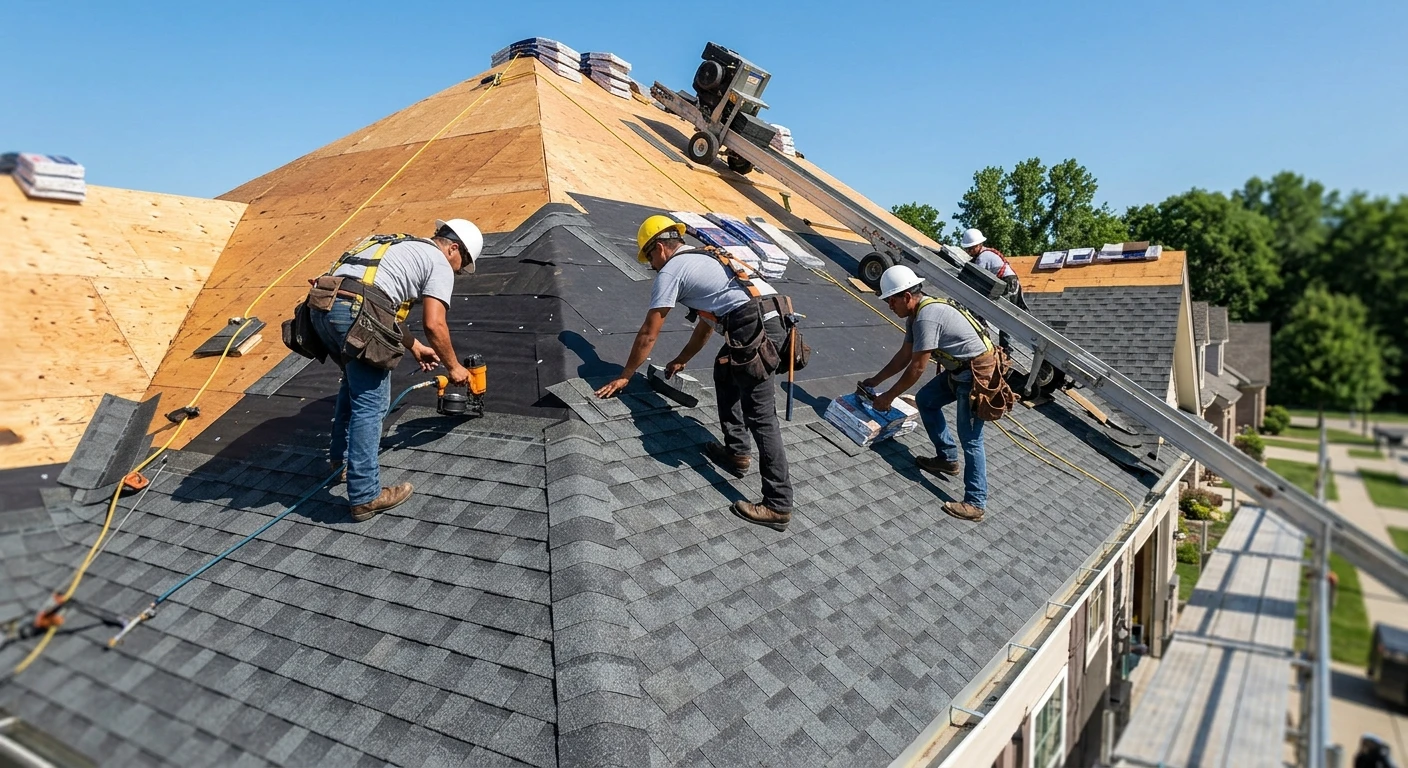
The shingle vs metal roofing question comes up on almost every replacement we quote in Hutto. Metal costs roughly two to three times what asphalt does and lasts roughly two to three times as long. On paper that looks like a wash, which is exactly why the comparison needs more than the headline numbers. The real question is not which roof is better — it is which one is better for your building, your hail exposure and your time horizon.
The numbers side by side
| Architectural asphalt | Standing seam metal | Exposed-fastener metal | |
|---|---|---|---|
| Installed cost / sq ft | $5 – $9 | $12 – $20 | $7 – $12 |
| Typical 2,000 sq ft roof | $12,000 – $22,000 | $26,000 – $48,000 | $16,000 – $28,000 |
| Realistic life here | 20 – 28 yrs | 40 – 60 yrs | 25 – 40 yrs |
| Cost per year of service | ~$650 | ~$740 | ~$680 |
| Wind rating | 110 – 130 mph | Up to 140+ mph | Up to 120 mph |
| Hail outcome | Bruises, eventually fails | Dents, stays watertight | Dents, stays watertight |
| Heat reflectance | Low to moderate | High with cool coating | High with cool coating |
| Maintenance | Periodic repairs | Minimal | Fastener service every 10 – 15 yrs |
| Repairability | Easy, sectional | Specialist work | Straightforward |
The cost-per-year row is the one people find surprising. On a pure arithmetic basis the three options are close to level. That means the decision genuinely hinges on the non-cost factors.
Where metal clearly wins
Hail. This is the strongest argument in Central Texas. Hail bruises an asphalt mat and starts a clock; hail dents a metal panel and the panel keeps working. A dented standing seam roof is cosmetically marked and functionally intact, which is a genuinely different outcome after the kind of spring storm that crosses Williamson County most years.
Heat. A cool-rated metal roof reflects a large share of incoming solar radiation rather than absorbing it. In a Hutto August, on a house with limited attic insulation, that shows up on the electricity bill.
Low slopes. Standing seam performs at pitches where asphalt shingles are simply not rated to go. If you have a low-slope section, metal may not be a preference — it may be the only correct answer.
Time horizon. If you intend to be in the house for twenty-five years or more, metal means one roof instead of two, plus no tear-off cost and no disruption in year twenty-two.
Outbuildings. On a barn, shop or equipment shed, exposed-fastener metal is not really a debate. It is faster, cheaper per square foot than most alternatives, and appropriate to the structure.
Where asphalt clearly wins
Upfront cost. The gap is real and it is large. For many households the $14,000 difference on a typical Hutto roof is decisive on its own, and that is a legitimate reason.
Complex rooflines. Hutto's 2000s and 2010s subdivisions favor multi-gable roofs with numerous valleys, dormers and transitions. Every one of those is a custom-formed flashing detail on a metal roof, and both the cost premium and the risk of a bad install climb steeply with complexity.
Repairs. A damaged asphalt section can be replaced by any competent roofer for a few hundred dollars. Matching a metal panel profile and finish a decade later is harder and more expensive.
Shorter ownership. If you expect to sell within ten years, you will not recover the metal premium. Buyers value a newer roof; they rarely pay a metal premium for it.
HOA rules. Several of Hutto's newer planned communities, including sections of Star Ranch and Legends of Hutto, have architectural guidelines covering roofing materials, profiles and colors. Check before you price panels.
Two myths worth clearing up
"Metal roofs are noisy in the rain." On an open-framed barn, yes. On a house with solid decking, underlayment and an insulated attic beneath, a metal roof is no louder than asphalt. The reputation comes entirely from the barn case.
"Metal roofs attract lightning." They do not. Metal is conductive, which means a metal roof disperses a strike more safely than a combustible one, but it does nothing to make a strike more likely.
How this plays out in Hutto specifically
The split we see locally is fairly clean, and it follows the geography.
In the subdivisions — Star Ranch, Emory Farms, Creek Bend, Cottonwood Creek, Riverwalk, Legends of Hutto — asphalt remains the sensible default. Complex rooflines, HOA guidelines, and owners who typically move again within a decade or so all point the same way. Where we do push back is on grade: given Hutto's hail exposure and limited shade, Class 4 impact-resistant shingles are worth pricing on any of those roofs, and many Texas carriers discount premiums for them.
Out past the subdivisions — the acreage along FM 1660, toward Taylor on US-79, and north toward the county line — metal dominates and should. Barns and shops, simpler roof geometry, no HOA, longer ownership, and a fire-resistance benefit that matters during a dry Central Texas summer.
In Old Town and the Co-Op District, standing seam fits the agricultural-heritage architecture that redevelopment there has leaned into, and the simpler older rooflines suit it.
The one case where we would recommend metal to a subdivision homeowner without hesitation: you have already replaced one asphalt roof, you are staying put, and you would rather not do it a third time. At that point the arithmetic and the temperament line up.
Deciding
Ask yourself three questions. How long will you own this building? How complex is the roofline? And how would you feel about visible hail dents? Those three answers usually settle it.
More detail on each path: metal roofing in Hutto, TX and shingle roofing in Hutto, TX. Or call +1 (512) 297-7580 and we will price both on your actual roof.
Questions about your own roof?
Articles describe the general case. For what is happening on your roof in Hutto, call or text +1 (512) 297-7580 and describe it.